
Summary
- The management team at Archrock decided to acquire Elite Compression for cash and stock worth $410 million.
- This transaction is significant in size, and it should prove to be accretive to shareholders moving forward.
- One big thing to keep in mind is that while it will be beneficial, the move isn't being done at super attractive terms.
- Looking for a community to discuss ideas with? Crude Value Insights features a chat room of like-minded investors sharing investing ideas and strategies. Start your free trial today »
At a time when there is still uncertainty over many energy names, one company, Archrock (AROC), has decided to make a significant acquisition in order to bolster its service capabilities for the companies it performs work for. This move, the company’s acquisition of Elite Compression Services, a subsidiary of JDH Capital Company, as well as a corresponding asset sale, helps the firm to further focus its efforts on its core markets, will result in extra cash flow generation, and will help to boost shareholder value over the long run, but while these issues are all true, one shortfall is that the price paid in the acquisition, while not expensive, was not a bargain for shareholders. In all, this mitigates some of the upside associated with the move, but what management has said about the deal is accurate; the picture for shareholders should still be bullish nonetheless.
A look at the deal
In a press release issued the other day, the management team at Archrock announced that it had struck a deal to acquire Elite in a transaction valuing the firm at $410 million. Half of the deal’s value, $205 million, will be completed in cash, while the remainder will come in the form of the issuance of 21.7 million shares. This share count addition will dilute shareholders in the company by 14.3% given the 130.333 million shares of Archrock currently outstanding.
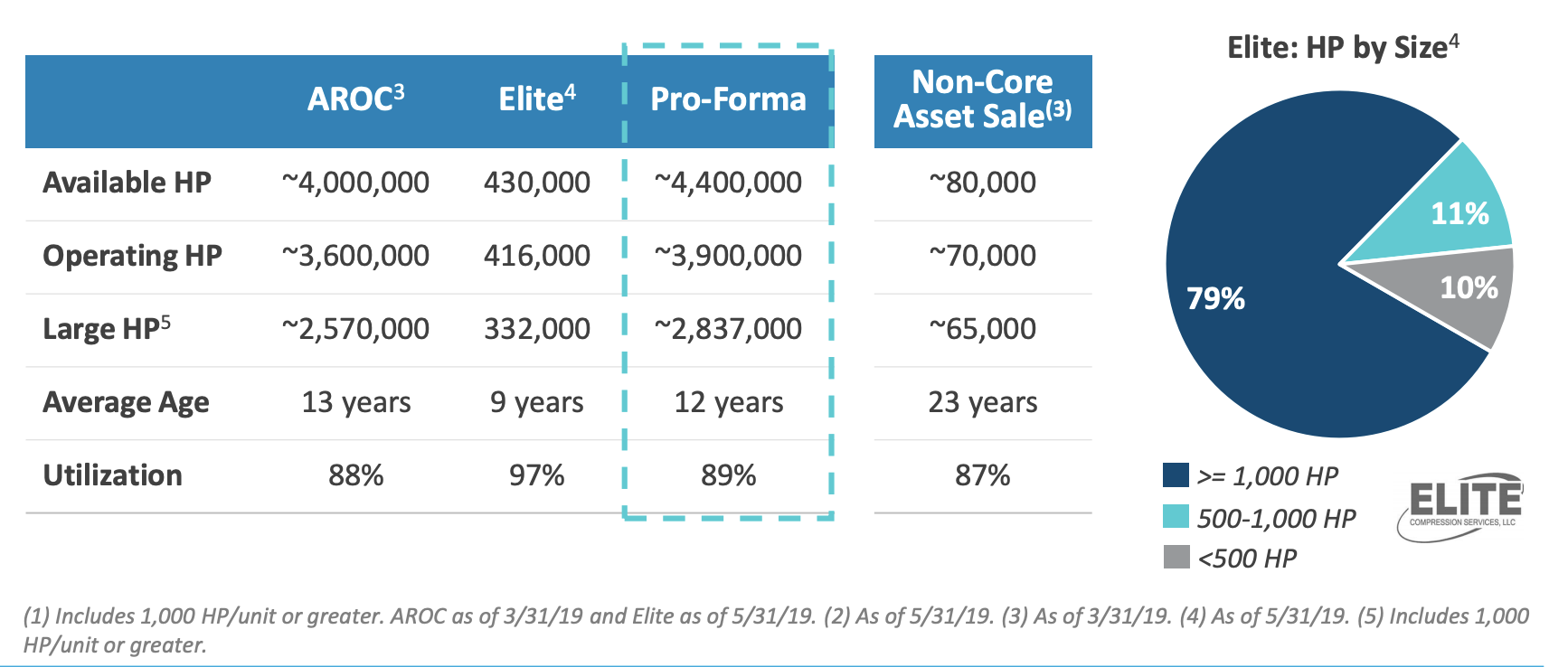
Taken from Archrock, Inc.
One way to look at the acquisition is to compare it to Archrock and how that company looks like both prior to and after the transaction. In the imageabove, you can see this in some detail. Archrock, according to management, will benefit significantly from the move, allowing its horsepower to rise by 430,000 to around 4.4 million from the roughly 4 million that the company has today. One downside to the acquisition is that the average remaining contract is around nine years compared to the 13 years on the books for Archrock prior to the transaction. This will, on the whole, reduce the average contract’s life for Archrock by a year.

