
Summary
- Halliburton has plunged 50% in the last 12 months and is thus now trading around its 10-year lows.
- While the energy sector has been in recovery mode in the last two years, Halliburton has exhibited lackluster results.
- However, thanks to the negative market sentiment, the stock has become extremely cheap.
Halliburton (HAL) is one of the more cyclical stocks in the S&P 500 Index. Due to its lackluster business performance, the stock has plunged 50% in the last 12 months. Consequently, while S&P is trading at a fresh all-time high, Halliburton is trading around its 10-year lows, where it was trading in the Great Recession.
Although the market is justified to be disappointed by the slow recovery of the company, it has punished the stock to the extreme. As a result, the stock has become a conviction buy at its current level for value and income investors.
Business Overview
Halliburton celebrated its 100-year anniversary this year. It is one of the world’s largest providers of products and services to the energy industry. It has operations in more than 80 countries but generates 60% of its revenues in North America.
Halliburton was severely affected by the downturn of the energy sector, which began with the collapse of the price of oil five years ago. This is clearly reflected in the performance of the company, which posted losses in 2015 and 2016. However, the price of oil bottomed in early 2016 and has doubled since then. This rebound has led the energy sector to return to recovery mode in the last two years.
U.S. oil production has been posting new all-time highs year after year and is expected by EIA to keep climbing to new record levels in the upcoming years. This production boom will continue to be driven by onshore oil production. As Halliburton heavily relies on this type of production, this trend should provide a strong boost in its results.
Unfortunately, the recovery of Halliburton has been much weaker than expected. In 2018, the company posted earnings per share of $1.89, which were less than half of its pre-crisis earnings per share. Even worse, Halliburton is expected to post much lower earnings per share this year, around $1.35.
In the first quarter, its revenue in North America decreased 7% over last year’s quarter while international revenue rose 11%.
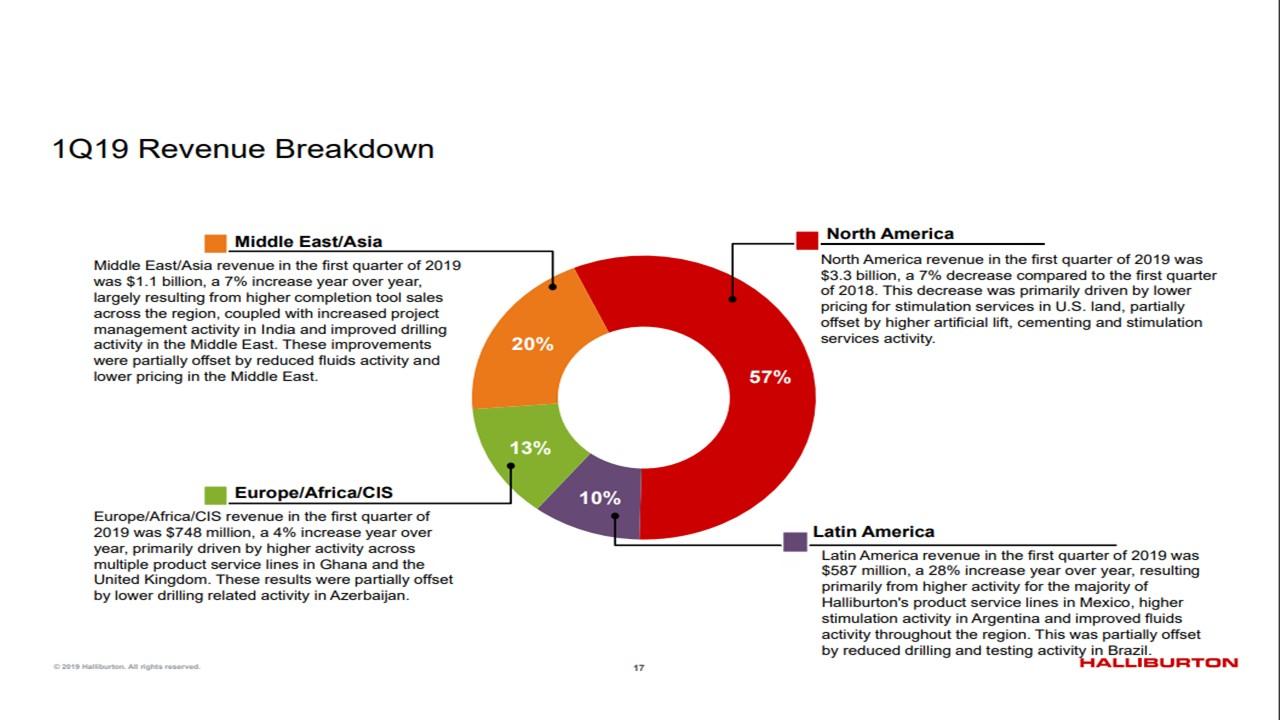
Source: Investor Presentation
While the great divergence can be explained by the wide discount of WTI to Brent, Halliburton is also facing some negative trends in North America. Shale oil producers have become much more conservative in their budgets. They thus try to grow their output within the limits posed by their cash flows. This conservative approach has resulted from the recent fierce downturn, which drove some producers out of business and thus provided a lesson to the survivors.

