
Summary
- Drug manufacturers are under pressure due to patent expirations and political pressure to reduce healthcare costs. In the case of Bristol-Myers Squibb, the Celgene acquisition is an additional risk factor.
- Nevertheless, the company is still producing strong financial performance, and the business is well positioned for solid growth in the years ahead.
- Looking at valuation ratios, multi-factors analysis and dividend yield, Bristol-Myers Squibb is attractively valued across the board.
- If management keeps leading the business in the right direction, the stock could deliver considerable gains from current valuation levels.
- Looking for a portfolio of ideas like this one? Members of The Data Driven Investor get exclusive access to our model portfolio. Start your free trial today »
Bristol-Myers Squibb (BMY) is under considerable pressure, the stock has declined by more than 25% from its highs of the year due to generalized negativity towards the drug manufacturing sector and the uncertainty produced by the Celgene (CELG) acquisition.
On the other hand, the business remains fundamentally solid, and the stock is attractively valued at current levels. The risk versus reward trade-off in Bristol-Myers Squibb looks clearly convenient going forward.
The Fundamentals Remain Solid
In spite of the risk factors affecting Bristol-Myers Squibb in the middle term, the most recent financial report from the company confirms that the business keeps firing on all cylinders. Bristol-Myers Squibb delivered both revenue and earnings above market expectations last quarter, and the business looks healthy across the board.
Total revenue reached $6.3 billion during the quarter, an increase of 10% versus the same quarter in the prior year. U.S. revenues increased by 14% to $3.7 billion, and international revenues grew 5%. When adjusted for foreign exchange impact, international revenues increased by 12%. Non-GAAP earnings per share increased by a vigorous 17% year over year.
Taking a look at the company's different products, Bristol-Myers Squibb is doing well in its leading drugs, which bodes well in terms of evaluating potential performance going forward.
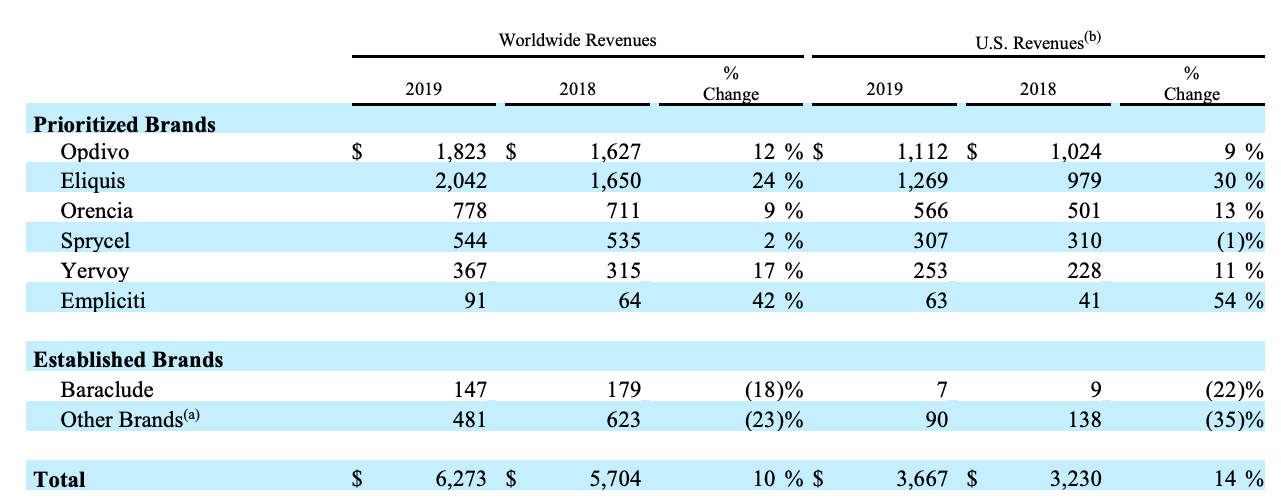 Source: SEC filings
The Celgene acquisition will necessarily carry some integration risks, but the deal makes sense from both a strategic and financial perspective. According to management, the combined company will be the top player in oncology and cardiovascular and one of the top five in immunology and inflammation. The new company will have nine blockbusters and six near-term launch candidates and more than 50 Phase 1 and 2 clinical programs.
Based on calculations from Bristol-Myers Squibb, the Celgene acquisition will be 40% accretive to earnings per share in year one and 10% accretive each year thereafter through 2025.
Management estimates about the potential impact of acquisitions should always be taken with a grain of salt, and there are several moving parts to consider when evaluating financial performance going forward. Patent expirations and increasing competition are obvious considerations, and there is increasing political pressure for more regulations to reduce drug costs lately.
Nevertheless, even when incorporating these risk factors, chances are that Bristol-Myers Squibb will continue delivering solid revenue and earnings for shareholders in the years ahead.

