
Summary
- We believe in the high $60 range that Exxon Mobil is a strong buy.
- Exxon recently reported earnings and despite weakness on the headline numbers, the underlying fundamentals of the name remain intact.
- Although Capex has increased, you can expect management will cut this heavily to survive any prolonged downturn.
- We are looking for $3.17 to $3.35 in 2019 EPS.
- Looking for a helping hand in the market? Members of BAD BEAT Investing get exclusive ideas and guidance to navigate any climate. Get started today »
We believe in the high $60 range that Exxon Mobil (XOM) is a strong buy. Exxon has survived every major downturn in energy and emerged stronger each time. Trading firms like ours have been able to play the swings, but we believe that with oil completely retracing from the Saudi attack that hit supply output temporarily, it is time for long-term investors to step back into the name as we see oil stabilizing in the $50's and Exxon taking appropriate steps to control expenses, and at this point in the oil cycle it has a lot of room left to cut. While pricing impacts revenues, expect Capex spending to remain elevated as the company brings new projects online, but these can be cut and quickly. With this flexibility, as we move forward, we expect substantial improvement in all segments as oil prices stabilize if not rebound. Investors will be further paid a near 5% dividend yield at these levels. Exxon recently reported earnings and despite weakness on the headline numbers, the underlying fundamentals of the name remain intact. In this column, we will discuss trends in several of the critical metrics you should watch for, in addition updating our 2019 expectations.
Pricing of course pressures revenues
Obviously the price of oil and gas is what drives revenue for the company, in addition to volumes. As oil prices move higher, Exxon and its competitors make more money. With that said, revenues have begun to fall along with energy prices. While volumes matter as do movements in balance sheet line items, there is a direct correlation with oil prices and revenues for the company. Oil prices rebounded from 2016 into 2019 but have since started facing weakness. This led to the first drop in Q2 2019 revenues since 2016:
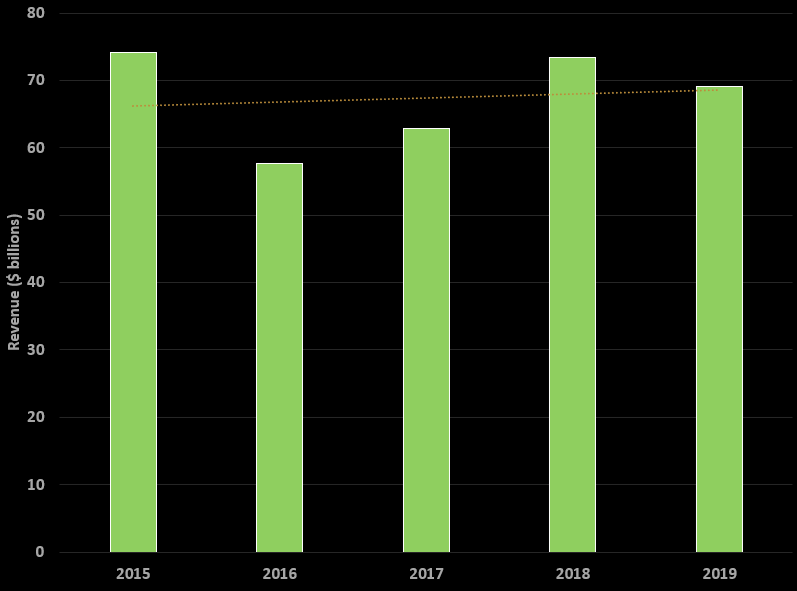
Source: SEC filings, graphics by BAD BEAT Investing
This result snapped a three-year winning streak. The trend was positive after recovering from the huge declines in energy prices in 2015-2016. Today's pricing environment is slightly better than it was in Q2, but is still weaker than this time a year ago. The decline in oil prices directly hit revenues. Revenues were down from last year, but were actually stronger than expected in the quarter. Revenues fell to $69.1 billion from $73.5 billion last year which is a decline of 26%. The results were better than the Street consensus by $1.26 billion. So that was a positive and something to keep in mind here in Q3. The company is performing well. Let's talk more about why revenues were down.

