
Summary
- Penn Virginia Corporation makes for an excellent prospect for long-term oil and gas investors to consider.
- The company looks attractive and has fairly low leverage, giving it good chances moving forward.
- There are better names out there, but this fits into the upper echelon of prospects to keep in mind.
- Looking for a helping hand in the market? Members of Crude Value Insights get exclusive ideas and guidance to navigate any climate. Get started today »
One oil and gas E&P (exploration and production) firm that I came across recently was Penn Virginia Corporation (OTC:PVAC), a small-cap operator in the space with a market capitalization of $393.23 million. With fairly low leverage, strong production growth this year versus 2018, and the prospect of being free cash flow positive moving forward, the business makes for an appealing prospect for long-term investors in this space to consider.
Setting the stage for cash flow
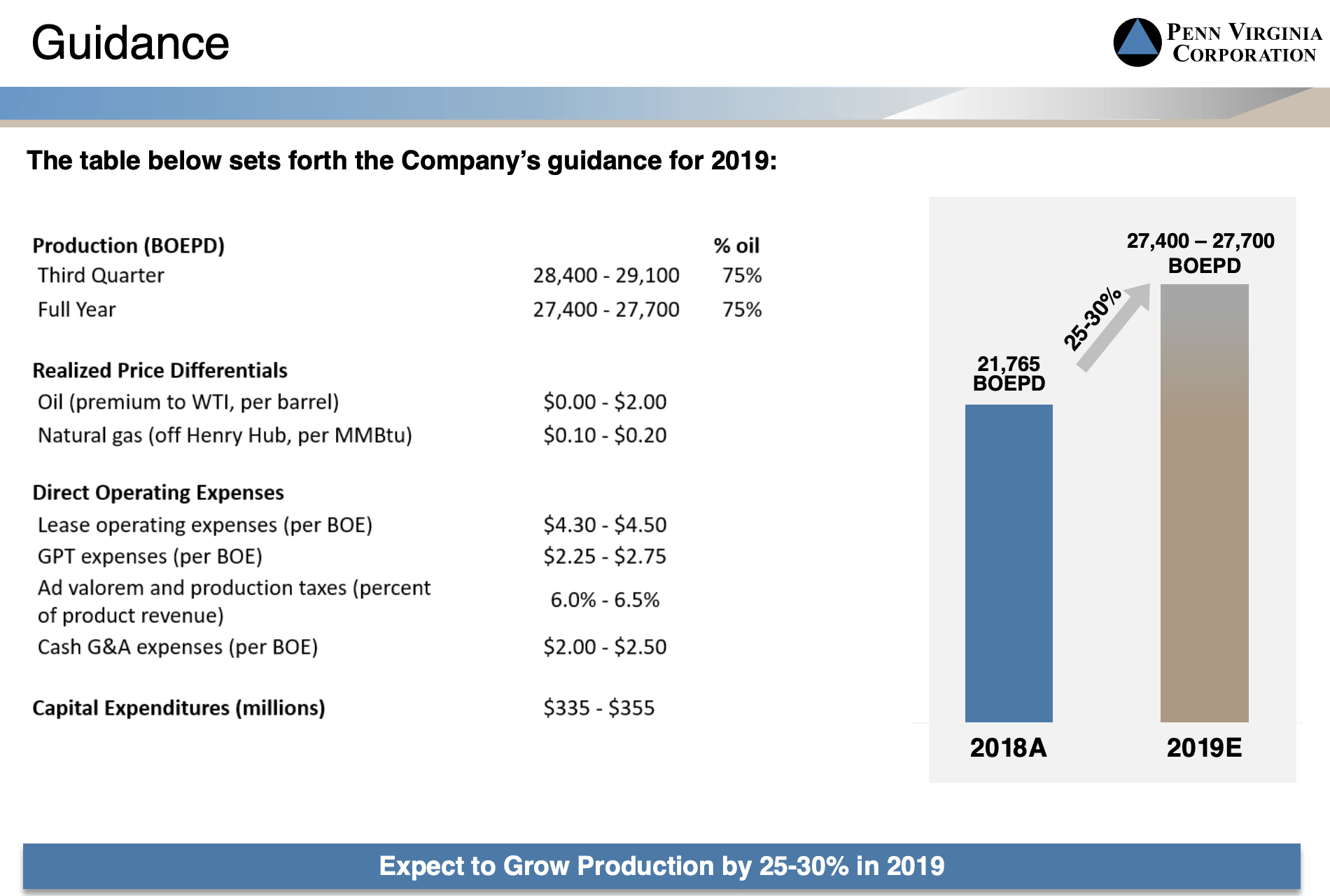
Before I dive into my model where I calculated the company’s cash flow metrics, we should first discuss the assumptions I used to arrive at my conclusions. As with other players in the space in recent months, I relied as heavily as possible on management’s own guidance. This can be seen in the image below. As you might expect by now, if you’re a regular reader of mine, Penn Virginia falls about in the middle in terms of what kind of guidance and how much the management team at the business is willing to give out.
 *Taken from Penn Virginia Corporation
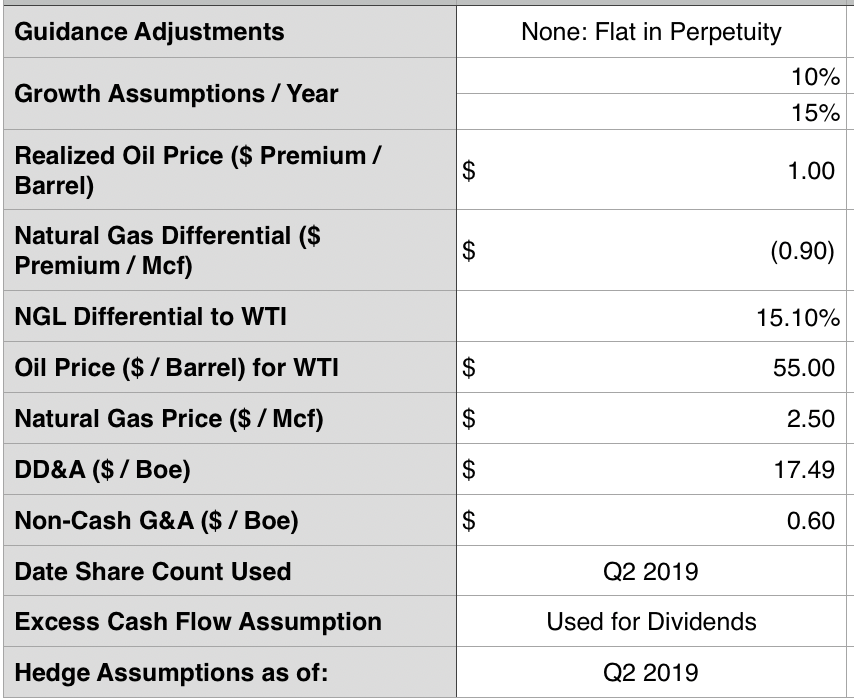
In addition to relying on the mid-point for all assumptions provided by management, I had to go through the company’s historical financial filings to figure out which other assumptions are needed to arrive at a reasonably-accurate cash flow analysis. The fruits of my labor can be seen in the table below. This covers everything from differentials not discussed by management to non-cash expenses, and more.
 *Created by Author
While it may be tempting to move on from this point, it would be a mistake to do so without talking about some rather important assumptions that investors should keep in mind. Like most firms in this space, Penn Virginia’s management team is good at providing guidance for the current fiscal year, but not for subsequent years. This year, production is supposed to hit about 10.06 million boe (barrels of oil equivalent), up about 26.6% over 2018’s output. This was due to nearly $431 million in capex, plus the impacts of the firm’s late 2017 Devon acquisition for $205 million and the 2018 acquisition of its Hunt assets for $86 million.
This year, capex is forecasted to be lower at about $345 million, so it’s difficult to tell exactly how much, after 2019, this lower spending will affect the company’s production levels. To be conservative on this front, I decided to look at two realistic scenarios: one where production, with flat spending, continues to grow at a rate of 10% per annum through 2023, and a more aggressive (but perhaps not unreasonable) assumption of production growing at a rate of 15% per annum over the same period of time. Conservative investors would be wise to rely more on the 10% growth scenario.

