
Summary
- A gradual but accelerating shift in product mix from branded to generic drugs will adversely affect future earnings growth and profitability. Overall sales are substantially up year on year, but.
- Organic growth opportunities appear limited in an industry that has reached a certain degree of maturity, but inorganic growth via acquisitions remains a likely catalyst for further sales increases and.
- Legal issues continue to dog the company, as a motion to dismiss a class action lawsuit related to generic drug price fixing was dismissed, adding to an already challenging legal.
Profit Margin Takes a Hit
Higher and higher concentration of lower-margin generics over branded drugs in a shift toward an increasingly unfavorable product mix. Operating margin has taken a sizable hit in recent quarters, thanks to that revenue mix shift. Specialty drug pricing helped to soften the blow of generic price deflation. For example, sales of biologics are a main driver of revenue growth thanks to the inelasticity of pricing and the continued rise of chronic diseases and related healthcare. Simultaneously, there is a deceleration of branded drug price inflation. There is even continued softness in European markets, thanks to less negotiating power and more stringent price controls.
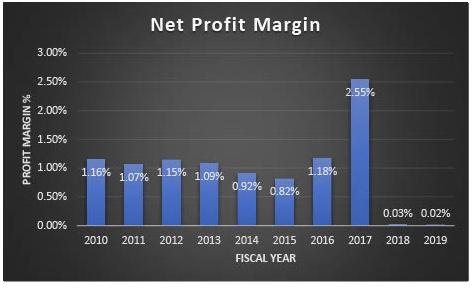
Margin compression resulting from a shift away from premium pricing of branded drugs towards the relative bargain of generics, puts a real crimp on profitability. It is important to note, however, that McKesson remains in a strong competitive position, in a highly concentrated industry, with relatively high barriers to entry. Despite the current headwinds, McKesson remains the largest drug distributor in the world and benefits from significant advantages of scale and valuable existing relationships that would be difficult for any new entrants to match.
Growth Opportunities Limited
Mergers and acquisitions have traditionally been a key driver of growth at McKesson, and thanks to a maturing industry, will likely have to do so more and more to boost any future growth. The company differs from peers in that it also often chooses to “make vertical acquisitions” and keep as many services in-house as possible, rather than contract out certain aspects of the pharmaceutical and medical product supply chain; MCK essentially has endeavored to become a sort of one-stop shop for such services.
The main part of McKesson’s business is driven by “drug pricing, drug mix (generics vs. branded drugs), and volume,” according to Soo Romanoff at Morningstar. The consolidation in the industry, namely with its retail pharmaceutical provider customers such as CVS, has afforded increasing customer leverage, and therefore led to less and less favorable negotiations on the pricing of its services, further pressuring profit margins. McKesson is now sufficiently large to the point that inorganic growth through acquisitions will likely outpace any organic growth through rising sales. In such a highly-regulated and cost-intensive business, scale is important, and McKesson is well-positioned due to its sheer size, existing relationships, and even its layers of vertical integration. Interestingly, “in the past decade McKesson has invested approximately $20 billion between capital expenditures ($4.7 billion) and acquisitions ($15.3 billion) in order to strengthen its position in a mature industry,” says Morningstar.
Scale definitely helps, but an uncertain drug pricing environment and growing customer leverage limit potential growth. As such, operating margins have remained in a state of decline in recent years, and are highly likely to decline further. One area where the company sees cause for some optimism, however, is in the nascent and expanding “telehealth” market, where McKesson is a key player, according to MarketExpert24. “Telehealth” is the “utilization of advanced data and correspondence innovations,” i.e. the integration and coordination of various aspects of healthcare and related services, including those related to drug distribution. Competitors in that growing space include Medtronic Inc., Cisco Systems, GE Healthcare, Allscripts Healthcare, Siemens Healthineers, and Honeywell, to name a few.

