
Summary
- It is likely that buybacks of at least 20M shares have happened after the quarterly results were released in September.
- Assuming the reduced share count of 70M shares, future EPS and intrinsic value per share are greater than before.
- With a short interest of 67M shares as of 11/15, news of share repurchases should cause a short squeeze.
- Short squeeze notwithstanding, cost reductions as well as debt and share count reductions should result in EPS of over $4 in 2021.
GameStop (GME) will report quarterly results in two weeks. While the earnings and cash flow numbers will be interesting to see, the most important metric I am looking for is how many shares they bought back after the last quarterly results have been released in September. If, as I expect, they repurchased shares, the stock is set up for explosive growth. We may see double-digits in a matter of months. With the company becoming more focused and streamlined, share repurchases would set the stage for a significant upside in the next couple of years with share prices reaching over $15.
I have originally written about GameStop when its share price was $3.82 and there was a great deal of uncertainty. Now I would like to provide an update with what I expect to be the most likely scenario for the company’s financial performance and the intrinsic value of its shares. I will use both the information provided by the management on the conference call that followed the last earnings release in September as well as an expectation of a modest share buyback.
Prior-Quarter Results
I have written about the prior quarter here. The operational and financial performances were as I expected at the time. One positive number was a decline in inventories of $182M compared to prior year. Another item was the writedown of goodwill to zero, meaning there is no more goodwill to write down. Goodwill and intangible asset writedowns in the past resulted in reported negative earnings, which some people took literally. This distortion is now gone.
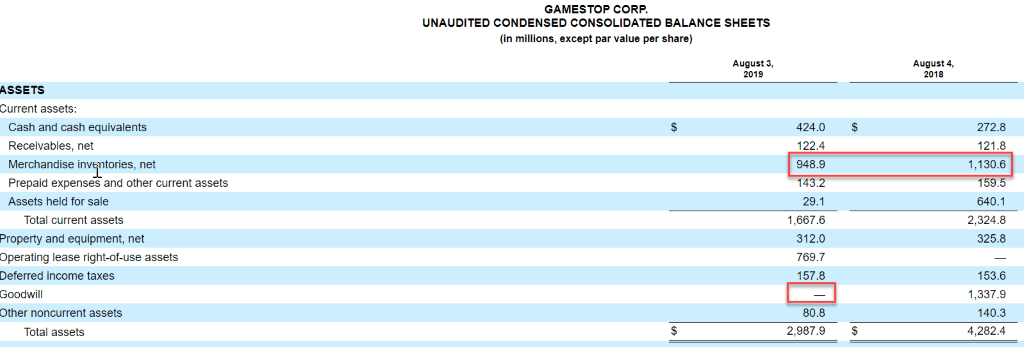
Source: GME Form 10-Q
Focusing on the Core Business
On the call, GameStop’s CEO George Sherman indicated in no uncertain terms that the company will not waste capital and will not diversify.
We will be disciplined with our approach to innovation by focusing on initiatives that will benefit the core video game business and leverage our current portfolio of assets, but not require significantly more capital growth.
In fact, we intend to maintain our historical annual capital expenditure levels and redirect some of those funds toward these initiatives. We are out of the diversification business. We will test and learn before we deploy and our decision-making will be driven by a disciplined approach to capital allocation. We will not under any circumstances debt to farm.
Source: George Sherman, CEO, on the conference call, emphasis mine
Profit Improvement Initiatives
The company expects to save over $200M a year by 2021. From the same conference call:
As a result, our results over the coming few quarters will not be sales-driven, but we believe will reflect the strengthening of our core business with expanding margins, disciplined expense management, and capital expenditures, and finally, strong and growing free cash flow.
In that light, we expect the overall annualized run rate of our profit improvement initiatives to be over $200 million in 2021 as we execute on them throughout the rest of 2019 and through 2020.
The company also mentioned that the run rate of improvement achieved YTD was $40M per year. From the Q&A session:
So it's all very new, but it is now in effect, we think of that call it $100 million of cost reduction opportunity has been roughly 40% complete now. And that's a combination of structural changes that we made as well as some indirect procurement initiatives that have taken hold. So, that gives us a level of confidence again to commit to a $200 million number because we made very, very good progress on -- to get there.
Guidance Without Buybacks
Assuming no buybacks, the following was stated:
Historically, there is a fair amount of seasonality in our business and our working capital throughout any fiscal year. In that light, after adjusting for the timing of certain invoice payments related to holiday 2018 inventory that were paid after the end of the fiscal year last year, we expect our adjusted free cash flow for fiscal 2019 to be in the $225 million to $250 million range. Finally, given my earlier comments related to our sales outlook for both the industry and our business, we expect adjusted diluted earnings per share for fiscal 2019 to be in the $1.15 to $1.30 range.
At the time, with the share count of about 90M, the "adjusted" FCF per share would have been $2.50-2.78 and EPS of $1.15-1.30.

